UN2814 感染性物质,对人感染
INFECTIOUS SUBSTANCE, AFFECTING HUMANS
基本信息
| UN 编号 | UN2814 |
|---|---|
| 中文名称 | 感染性物质,对人感染 |
| 英文名称 | INFECTIOUS SUBSTANCE, AFFECTING HUMANS |
| 危险类别 | 第6.2类 |
| 包装类别 | 本条目未划定包装类别 |
| 海洋污染物 | 否 |
| 有限数量 | 0 |
| 例外数量 | E0 |
| EmS 应急措施 | F-A,S-T(F-A, S-T) |
物质性质与外观
对人或动物都具有危险性的物 质。
Substances which are dangerous to humans or to humans and animals.
出处:IMDG Code 42-24 第 705 页
包装要求
本条目适用的包装导则: P620 ;有限数量 0,例外数量 E0。
P620
P620 本导则适用于UN 2814和2900。 只要符合第4.1.8节的特殊规定,允许使用下列包装: 符合第6.3章规定并经相应批准的包装,由以下材料组成:.1 内包装包括: (ⅰ) 防漏主容器; (ⅱ) 防漏辅助包装; (ⅲ) 除用于固体感染性物质外,放置在主容器和辅助包装之间的足以吸收全部内容物的吸收材料;如果一个辅助包装内放置几个主容器,则须单独包装或分开,以防止它们之间接触;.2 硬质外包装: 桶(1A1、1A2、1B1、1B2、1N1、1N2、1H1、1H2、1D、1G); 箱(4A、4B、4N、4C1、4C2、4D、4F、4G、4H1、4H2); 罐(3A1、3A2、3B1、3B2、3H1、3H2)。 其最小外部尺寸不得小于100mm。 补充规定: P620 装有感染性物质的内包装不得与装有不相关类型货物的内包装组合在一起。根据第 1.2.1和5.1.2节的规定,可将多个完整包件集合包装,这种集合包装可装有干冰。当使用干冰或其他有窒息风险的制冷剂作为冷却剂时,须适用第5.3.3节的要求。 除特殊托运的货物(如需要特殊包装的完整器官)外,还须适用下列补充规定: (a) 在环境温度或更高温度下运输的物质。主容器须为玻璃、金属或塑料。须采用确保防漏密封的积极措施,如热封、裙边塞或金属压接密封。如果使用螺旋盖,则须通过积极措施固定,例如胶带、石蜡密封胶带或制造的闭合装置。 (b) 以冷藏或冷冻方式运输的物质。须将冰、干冰或其他制冷剂放置于辅助包装周围,或将其放置在外包装中,并按第 6.3.3 节的规定标记一个或多个完整的包装。须提供内部支撑,以便在冰或干冰消融后将辅助包装或集合包装固定到位。 当使用干冰或其他有窒息风险的制冷剂作为冷却剂时,须适用第 5.3.3 节的要求。如果适用冰,其外包装或集合包装须防漏。如使用干冰,其外包装或集合包装须允许释放二氧化碳气体。主容器和辅助包装须在所用制冷剂的温度下保持完整性。 (c) 在液氮下运输的物质。当使用液氮作为冷却剂时,须适用第 5.3.3 节的要求。须适用能够承受极低温度的塑料主容器。辅助包装也须能承受极低的温度,在大多数情况下须单独放置于主容器上方。还须满足液氮运输的规定。主容器和辅助包装须在液氮温度下保持其完整性。 (d) 装冻干物质也可以在主容器中运输,主容器是火焰密封的玻璃安瓿瓶或装有金属密封件的橡胶塞小玻璃瓶。 无论预定的运输温度如何,主容器或辅助包装均须能够承受不少于 95kPa 压差的内部压力而不发生泄露。该主容器或辅助包装还须能够承受-40℃至+55℃范围内的温度变化。 其他危险货物不得与第 6.2类感染性物质装入同一包装,除非是为了保持感染性物质活力、稳定性或防止其危险性降低或被中和所需的。每个装有感染性物质的主容器中可以装 30mm 或更少的第 3类、第 8类或第 9 类危险货物。这些少量的第 3类、第 8类或第9类危险货物在按照本包装导则包装时不受本《规则》任何补充规定的约束。 主管当局可根据第4.1.3.7条的规定批准使用替代包装来运输动物材料。
P620 This instruction applies to UN Nos. 2814 and 2900. The following packagings are authorized, provided the special packing provisions of 4.1.8 are met: Packagings meeting the provisions of chapter 6.3 and approved accordingly consisting of:.1 Inner packagings comprising: (i) leakproof primary receptacle(s); (ii) a leakproof secondary packaging; (iii) other than for solid infectious substances, an absorbent material in sufficient quantity to absorb the entire contents placed between the primary receptacle(s) and the secondary packaging; if multiple primary receptacles are placed in a single secondary packaging, they shall be either individually wrapped or separated so as to prevent contact between them;.2 A rigid outer packaging: Drums (1A1, 1A2, 1B1, 1B2, 1N1, 1N2, 1H1, 1H2, 1D, 1G); Boxes (4A, 4B, 4N, 4C1, 4C2, 4D, 4F, 4G, 4H1, 4H2); Jerricans (3A1, 3A2, 3B1, 3B2, 3H1, 3H2). The smallest external dimension shall be not less than 100 mm. Additional provisions: Inner packagings containing infectious substances shall not be consolidated with inner packagings containing unrelated types of goods. Complete packages may be overpacked in accordance with the provisions of 1.2.1 and 5.1.2: such an overpack may contain dry ice. When dry ice or other refrigerants presenting a risk of asphyxiation are used as a coolant, the requirements of 5.5.3 shall apply. Other than for exceptional consignments, such as whole organs which require special packaging, the following additional provisions shall apply: (a) Substances consigned at ambient temperatures or at a higher temperature. Primary receptacles shall be of glass, metal or plastics. Positive means of ensuring a leakproof seal shall be provided, e.g. a heat seal, a skirted stopper or a metal crimp seal. If screw caps are used, they shall be secured by positive means, e.g. tape, paraffin sealing tape or a manufactured locking closure; (b) Substances consigned refrigerated or frozen. Ice, dry ice or other refrigerant shall be placed around the secondary packaging(s) or alternatively in an overpack with one or more complete packages marked in accordance with 6.3.3. Interior supports shall be provided to secure secondary packaging(s) or packages in position after the ice or dry ice has dissipated. When dry ice or other refrigerants presenting a risk of asphyxiation are used as a coolant, the requirements of 5.5.3 shall apply. If ice is used, the outer packaging 4 or overpack shall be leakproof. If dry ice is used, the outer packaging or overpack shall permit the release of carbon dioxide gas. The primary receptacle and the secondary packaging shall maintain their integrity at the temperature of the refrigerant used; (c) Substances consigned in liquid nitrogen. When liquid nitrogen is used as a coolant, the requirements of 5.5.3 shall apply. Plastics primary receptacles capable of withstanding very low temperature shall be used. The secondary packaging shall also be capable of withstanding very low temperatures, and in most cases will need to be fitted over the primary receptacle individually. Provisions for the consignment of liquid nitrogen shall also be fulfilled. The primary receptacle and the secondary packaging shall maintain their integrity at the temperature of the liquid nitrogen. (d) Lyophilized substances may also be transported in primary receptacles that are flame-sealed glass ampoules or rubber-stoppered glass vials fitted with metal seals. Whatever the intended temperature of the consignment, the primary receptacle or the secondary packaging shall be capable of withstanding, without leakage, an internal pressure producing a pressure differential of not less than kPa. This primary receptacle or secondary packaging shall also be capable of withstanding temperatures in the range 40C to 55C. - ° + ° Other dangerous goods shall not be packed in the same packaging as class 6.2 infectious substances unless they are necessary for maintaining the viability, stabilizing or preventing degradation or neutralizing the hazards of the infectious substances. A quantity of 30 mL or less of dangerous goods included in classes 3, 8 or 9 may be packed in each primary receptacle containing infectious substances. These small quantities of dangerous goods of classes 3, 8 or 9 are not subject to any additional provisions of this Code when packed in accordance with this packing instruction. Alternative packagings for the transport of animal material may be authorized by the competent authority in accordance with the provisions of 4.1.3.7.
出处:IMDG Code 42-24 第 220 页(4.1.4.1)
中型散装容器(IBC)要求
本条目无中型散装容器(IBC)运输要求。
罐柜运输要求
BK2
BK2 条文尚未录入本库。
运输标签与标记
本货物包件应张贴以下标签与标记:
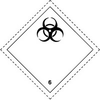 6.2
6.2感染性物质 6.2
特殊规定(Special Provisions)
本条目适用特殊规定: 318、341。
SP 318
就运输单证而言,正确运输名称须用技术名称(见第3.1.2.8条)进行补充。技术名称不必在包件上显示。如果拟运输的感染性物质属于未知,但怀疑其符合纳入A类并划为UN 2814或UN 2900的标准,须在运输单证上的正确运输名称后的括号中显示“疑似A类感染性物质”,但在外包装上不必显示。
For the purposes of documentation, the proper shipping name shall be supplemented with the technical name (see 3.1.2.8). Technical names need not be shown on the package. When the infectious substances to be transported are unknown, but suspected of meeting the criteria for inclusion in category A and assignment to UN 2814 or UN 2900, the words “suspected category A infectious substance” shall be shown, in parentheses, following the proper shipping name on the transport document, but not on the outer packagings.
出处:IMDG Code 42-24 第 776 页
SP 341
采用BK2散货容器散装运输感染性物质仅被允许运输第1.2.1节所定义的动物材料中的感染性物质(见第4.3.2.4.1条)。
Bulk transport of infectious substances in BK2 bulk containers is only permitted for infectious substances contained in animal material as defined in 1.2.1 (see 4.3.2.4.1).
出处:IMDG Code 42-24 第 778 页
积载与隔离
| 积载与操作 | 积载类E SW1 H1 H5(Category E SW2 H1 H5) |
|---|---|
| 隔离 | SG50 |
积载操作代码(SW)
避开生活居住处所。
Clear of living quarters.
隔离代码(7.2.8)
按照第7.3.4.2.1、7.6.3.1.2或7.7.3.6条的要求与食品“隔离”。
Segregation from foodstuffs as in 7.3.4.2.1, 7.6.3.1.2 or 7.7.3.6.
同类其他 UN 号
- UN1051 氰化氢,稳定的,含水小于3%
- UN1092 丙烯醛,稳定的
- UN1098 烯丙醇
- UN1135 氯乙醇
- UN1143 巴豆醛或巴豆醛,稳定的
- UN1163 二甲肼,不对称
- UN1181 氯乙酸乙酯
- UN1182 氯甲酸乙酯
- UN1185 乙撑亚胺,稳定的
- UN1199 糠醛
- UN1238 氯甲酸甲酯
- UN1239 甲基氯甲基醚
延伸阅读
-
第 6.1 类毒性物质与农药出口:UN2810 / UN2902 / UN2761 怎么选,技术名称怎么补
农药出口最常见的退单原因不是类别错,而是技术名称没补。本文按 SP61 与 SP274 讲清农药条目的选择顺序、技术名称要求,以及 6.1 与 6.2 的分界。
-
危包证怎么办?船级社证、钢瓶证、SOC 罐证的区别
出口危险货物包装使用鉴定结果单(危包证)的办理逻辑,以及它和船级社证、钢瓶证、SOC 罐证分别在什么场景下用、向谁申请。
-
DG 申请表填写常见错误 TOP 10(附船公司退回原因)
DG 申请表(DGD)被船公司退回,十有八九是这十个问题。逐条列出错误表现、船司退回话术和正确填法。
要出这票货?直接生成 DG 申报资料
按 UN2814 自动带出类别、包装组、隔离要求与危包证清单,省掉翻书对表的时间。
生成 DG 申报资料 →